

A motorcycle chain breaker tool should be selected by the chain specification and the service operation—not by appearance or a broad “universal” label. For importers, distributors, wholesalers and motorcycle tool brands, the important questions are whether the tool matches the target chain, whether it only separates links or also supports pressing and riveting, and which pins and accessories are included in each configuration.
This guide explains the main selection points for motorcycle drive-chain tools, compares common tool configurations and outlines what to confirm before requesting a quotation or placing a wholesale order.
1. Understand what the chain tool needs to do
“Chain breaker” is often used as a broad product name, but different chain-service operations may require different tool functions. Before comparing products, define the job the customer needs to complete.
| Operation | What the tool does | What to confirm |
|---|---|---|
| Breaking / splitting | Pushes a chain pin out so the chain can be separated. | Supported chain specification, press-pin size and tool alignment. |
| Connecting-plate pressing | Presses a connecting plate into position on a compatible master link. | Whether the tool includes the correct press or plate adapter for the chain. |
| Riveting | Flares the ends of a compatible rivet-type master-link pin. | Riveting tip, supported master-link design and the chain maker’s specified procedure. |
Not every chain breaker supports all three operations. Some are designed for pin removal only, while combination kits may include components for breaking, pressing and riveting. A buyer should confirm the required operation rather than assume that “chain breaker” automatically means “breaker and riveter”.
2. Confirm the motorcycle drive-chain specification
Motorcycle drive chains are commonly identified by size designations such as 420, 428, 520, 525 and 530. These designations should be treated as a starting point for checking compatibility—not as proof that one tool configuration fits every chain carrying a similar label.
Before selecting a tool, collect the chain information available from the customer or chain manufacturer:
- The exact chain size and chain series, such as 420, 428, 520, 525 or 530.
- The chain manufacturer’s specification or product reference.
- The connecting-link type, including whether the application uses a clip-type or rivet-type master link.
- The required operation: pin removal, connecting-plate pressing, riveting, or a combination.
- Any specified press-pin, adapter or riveting-tip requirements.
Do not select a tool only from the motorcycle make or model. The chain fitted to a vehicle can vary by model year, modification or replacement-chain choice. Where the exact chain specification is not known, request the chain reference, dimensions or a clear sample before confirming fitment.
3. Match the tool design and press-pin setup
Once the chain specification and operation are clear, compare the tool’s construction and working components. A screw-driven spindle, press pin and support or alignment parts all need to suit the selected application. A replacement pin that physically fits the tool is not automatically suitable for every chain.
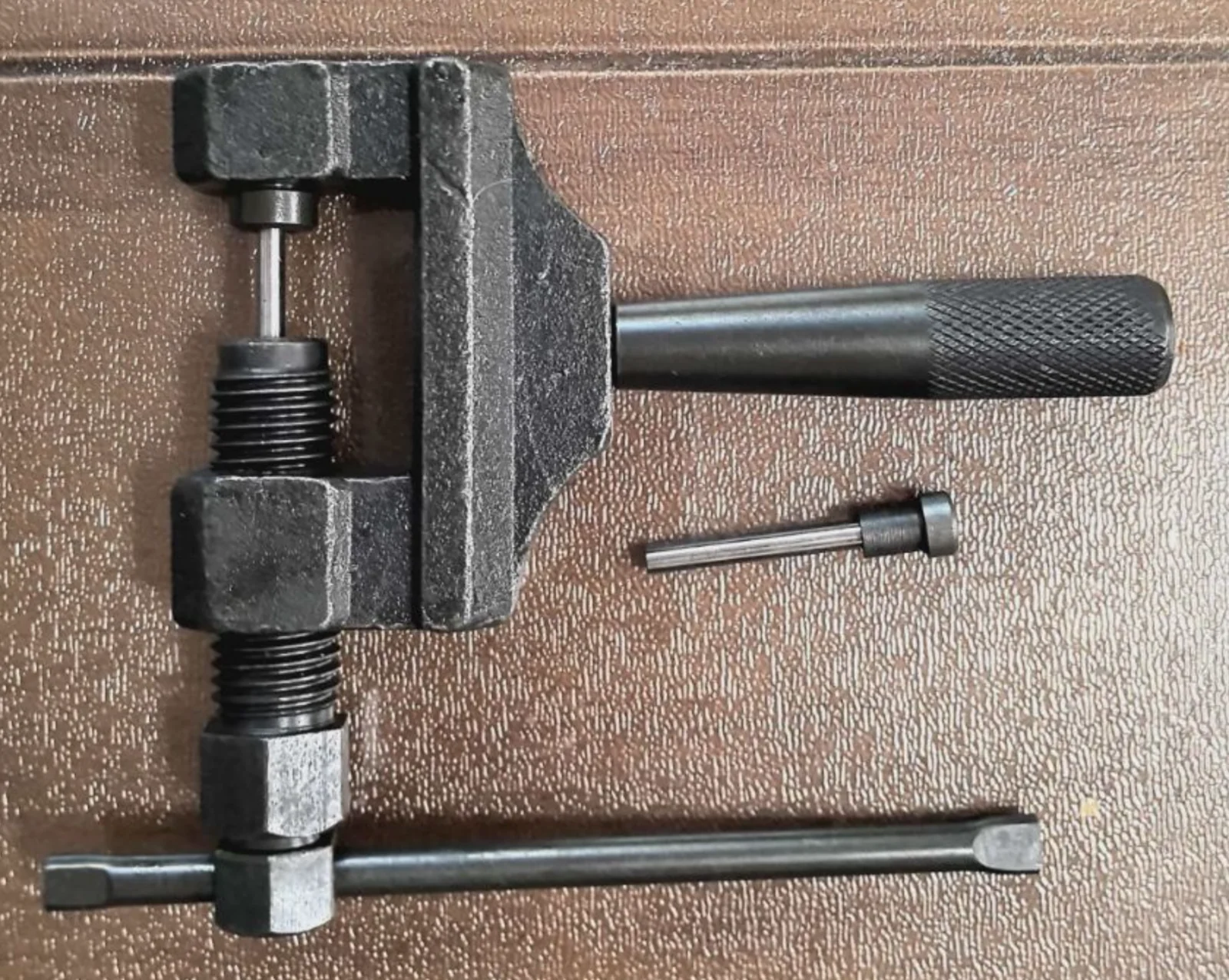
For the NACHEE NC-6024 Heavy Duty Motorcycle Chain Breaker Series, the published range covers selected 420–530 chain sizes. The series includes different configurations, such as a standard chain breaker, a 3.8 mm press-pin option, a designated chain-splitter and riveting set, and a threaded-spindle version. The functions and supplied accessories vary by configuration.
For buyers, this means the model or configuration should be stated in the inquiry. If replacement pins are needed, specify the tool version and confirm compatibility rather than ordering by pin diameter alone.
4. When should buyers choose a chain breaker and riveting kit?
If customers only need to separate chains, a breaker-only configuration may be sufficient. If their service work also includes installing compatible rivet-type master links, they may need a combination tool or kit with the appropriate riveting components.
The NACHEE NC-6026 Motorcycle Chain Breaker and Riveting Tool Kit Series offers several kit configurations. The published product information includes options listed for selected 520–630 chains, 520/525/530 applications, a separate universal set listed for 35#–630#, and a 13-piece service kit. Exact chain coverage and included components vary by kit.
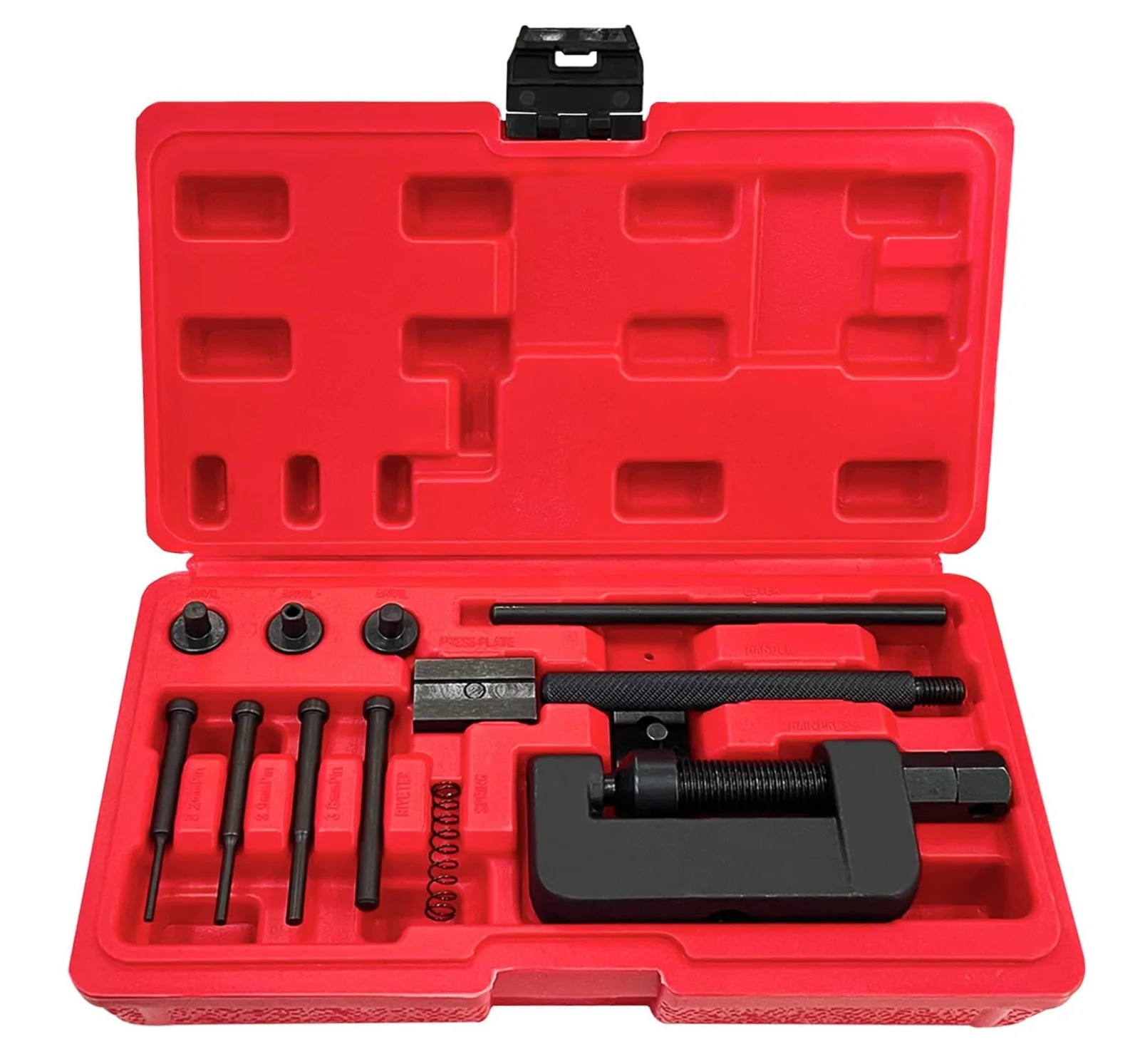
Replacement pins in 2.2 mm, 2.9 mm and 3.8 mm are listed separately for the NC-6026 range. Buyers should confirm which pin is compatible with the selected tool and chain application. Do not assume that all pin sizes are included in every kit.
One further point matters when comparing catalogues: the NC-6026 product information lists a separate universal set using a 35#–630# reference. That notation should not be treated as interchangeable with motorcycle drive-chain designations such as 420, 520 or 530. Ask the supplier to confirm the actual chain standard and supported application for the specific set.
5. Do not confuse motorcycle drive-chain sizes with other roller-chain references
Some chain tools are intended for general roller-chain separation rather than the motorcycle drive-chain applications described above. Their size references may look similar at a glance, but they belong to a different product specification and should be checked separately.
For example, the NACHEE NC-6025 Roller Chain Breaker and Pin Removal Tool is listed for #25, #35, #40, #41, #50 and #60 roller-chain sizes. It is designed for roller-chain separation. These # series references should not be directly compared with 420, 428, 520, 525 or 530 motorcycle drive-chain sizes.
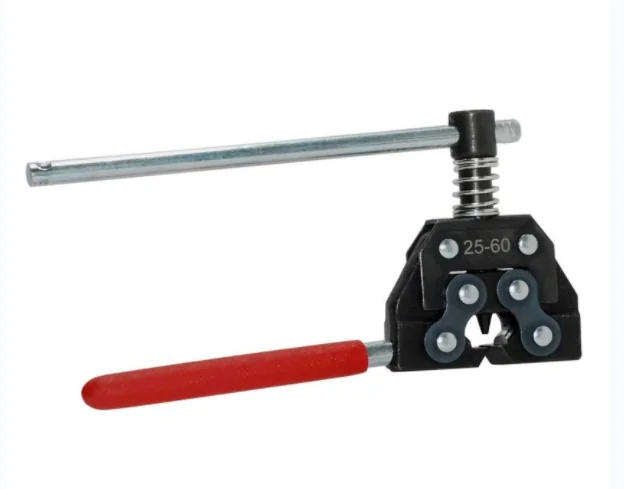
This distinction is useful for distributors whose catalogues include both motorcycle service tools and broader mechanical or industrial chain tools. Keeping the product families separate helps prevent incorrect substitutions and confusing product descriptions.
6. A buyer’s checklist before ordering
For a wholesale quotation, a short specification checklist helps the supplier recommend the right configuration and reduces the chance of receiving a tool that does not match the intended chain or service operation.
| Information to provide | What the buyer should confirm |
|---|---|
| Chain specification | Exact chain size, chain series and manufacturer reference where available. |
| Required operation | Breaking only, connecting-plate pressing, riveting, or combined functions. |
| Tool configuration | Breaker-only, press-pin option, threaded-spindle design or breaker/riveting kit. |
| Working components | Press-pin size, riveting tip, adapters and support components required for the application. |
| Kit contents | Number of pieces, included accessories, replacement pins and storage case, if applicable. |
| Order structure | Quantity by model or configuration, sample requirements and expected replenishment. |
| Branding and packaging | Logo marking, labels, retail or bulk packaging and carton requirements. |
If the application is not fully confirmed, send the chain reference, photos or a sample for review. It is better to identify missing information before the order is finalized than to rely on a broad compatibility statement.
7. How distributors can plan a chain-tool assortment
A distributor does not necessarily need every available configuration. The right assortment depends on the workshops and markets being served, the chain sizes customers request and whether customers need breaking-only tools or combined breaker and riveting kits.
- Start with customer demand. Review enquiries and sales by chain size and required service operation.
- Separate tool functions. List breaker-only tools and combination kits separately so buyers understand what each item does.
- Keep variants clear. Distinguish press-pin options, threaded-spindle versions and kits with riveting components.
- Plan spare parts carefully. Where replacement pins are offered, identify the compatible tool model and pin reference.
- Avoid unsupported fitment claims. Publish only the chain sizes and applications confirmed for each configuration.
This approach helps keep a product range useful without adding variants that do not serve a defined customer need. For a broader view of specialty-tool assortment planning, see Motorcycle Specialty Tools for Distributors: How to Plan a Product Range.
8. OEM/ODM, replacement pins and private-label requirements
For B2B projects, the discussion may go beyond selecting a standard chain tool. Buyers may need a mixed assortment, replacement pins, logo marking or private-label packaging. These requirements should be confirmed against the selected tool configuration.
NACHEE can discuss mixed-model quantities, laser logo marking and packaging options for relevant chain-tool projects. For replacement pins or kit combinations, provide the tool model, required function and target chain application so compatibility can be reviewed. MOQ, sample arrangements and lead time should be confirmed for the specific order rather than assumed to be the same across all configurations.
Frequently asked questions
Does every motorcycle chain breaker also rivet a chain?
No. Some chain breakers are designed for pin removal only. Riveting requires compatible components and a tool configuration intended for the master-link design. Confirm the functions included with the exact model.
Can one chain tool cover 420, 428, 520, 525 and 530 chains?
Not automatically. The NC-6024 range is listed for selected 420–530 chain sizes, but compatibility varies by model and configuration. Confirm the exact chain size and tool version before ordering.
Are 2.2 mm, 2.9 mm and 3.8 mm replacement pins interchangeable?
No. These are separately listed pin sizes for the NC-6026 range. Confirm the correct pin for the selected tool and application before purchasing replacements.
Are #35 and 520 chains the same size?
No. The # series roller-chain references and motorcycle drive-chain designations such as 520 are different size-reference systems. Do not assume compatibility based on the number alone.
What should I send when requesting a chain breaker quotation?
Provide the chain size and reference, the required operation, the preferred tool format, estimated quantity and any replacement-pin, logo or packaging requirements. If available, include photos or a sample reference to help confirm the application.
Discuss your chain-tool requirements with NACHEE
NACHEE supports importers, distributors, wholesalers and tool brands sourcing motorcycle chain-service tools and related specialty products. Share your target chain specifications, required operations, preferred configurations and estimated quantities to discuss suitable standard products and possible OEM/ODM options.
Explore the NC-6024 Chain Breaker Series · View NC-6026 Breaker & Riveting Kits · Request the Product Catalog · Discuss Your Project